AI Marketing Tools: The Complete Guide to Choosing and Using Them in 2026
The main categories of AI marketing tools, what each one does, how to choose the right stack, and how to connect them into a marketing system that drives revenue.
By the VANGAI team · · 12 min read
Key takeaways
- AI marketing tools use artificial intelligence to help plan, create, personalize, distribute, and measure marketing.
- The main categories are content creation, SEO and search visibility, email and personalization, social media, advertising, analytics, and conversational marketing.
- The right stack is small, integrated, and chosen around your goals rather than trends.
- Human strategy, brand judgment, and review remain essential for quality and trust.
What are AI marketing tools?
AI marketing tools are software applications that use artificial intelligence to help marketers do their work faster and better. They can research audiences, write and edit content, generate images, optimize websites for search, personalize emails, manage social media, improve ad performance, and analyze results.
The category has exploded. Nearly every marketing platform now includes AI features, and hundreds of new specialist tools appear each year. That abundance creates a real problem for business owners: which tools actually matter, and how do they fit together?
Why AI is changing marketing so quickly
Marketing is full of language, patterns, and data, exactly the areas where modern AI excels. McKinsey's research on generative AI identifies marketing and sales as one of the functions with the largest potential value from generative AI. The reasons are straightforward:
- Content demand is endless. Every channel needs a steady stream of fresh, relevant content.
- Personalization drives results. Customers respond to messages that feel relevant to them.
- Data is abundant but underused. Most businesses collect far more data than they analyze.
- Search is changing. AI powered search experiences are reshaping how people discover businesses.
AI helps with all four, but only when it is used thoughtfully.
The main categories of AI marketing tools
1. Content creation tools
These tools help draft blog posts, landing pages, social captions, emails, scripts, and product descriptions. Many can learn your brand voice from examples. Image and video generators create visuals for social posts, ads, and websites.
Best for: overcoming the blank page, producing variations, and repurposing content across channels.
Watch out for: generic writing, factual errors, and content that sounds like everyone else. Human editing is essential. See our AI content creation guide.
2. SEO and search visibility tools
AI tools can research keywords, analyze competitors, suggest content structure, audit technical issues, and help optimize pages. A new category focuses on generative engine optimization, making sure your business appears in AI generated answers from assistants and AI search features.
Best for: finding content opportunities and improving how search engines and AI systems understand your site.
Learn more: generative engine optimization.
3. Email marketing and personalization tools
AI can write subject lines, personalize content, choose send times, segment audiences, and predict which customers are likely to buy or churn.
Best for: increasing engagement and revenue from your existing audience. See AI email marketing.
4. Social media tools
AI helps plan calendars, draft posts, suggest hashtags, schedule publishing, summarize comments, and analyze performance.
Best for: maintaining a consistent presence without spending hours every day.
5. Advertising tools
Ad platforms increasingly use AI to target audiences, allocate budgets, and generate creative variations. Independent tools help write ad copy and analyze performance across platforms.
Best for: testing more creative faster and improving return on ad spend.
6. Analytics and insight tools
AI can summarize performance, explain changes, detect anomalies, and answer questions in plain language, such as "which channel drove the most qualified leads last month?"
Best for: turning data into decisions. See AI data analytics.
7. Conversational marketing tools
Chatbots and AI assistants on your website and messaging channels engage visitors, answer questions, qualify leads, and book meetings.
Best for: converting more of the traffic you already have. See AI lead generation.
8. Research and strategy tools
AI can summarize market research, analyze reviews and survey responses, profile competitors, and help build customer personas.
Best for: grounding strategy in real customer language and evidence.
How to choose the right AI marketing stack

More tools do not equal better marketing. Use this process to build a stack that works.
Step 1: Start with goals
Write down your top marketing goals for the next six to twelve months. Examples: double qualified leads from organic search, increase repeat purchases, or launch a new service successfully.
Step 2: Find the bottlenecks
For each goal, identify what slows you down. Is it content production, lack of data, slow lead response, or limited time for social media?
Step 3: Check what you already have
Many platforms you already pay for include AI features. Use them before adding new tools.
Step 4: Evaluate a short list
For each bottleneck, compare two or three tools on:
- Quality of output for your use case.
- Integration with your existing systems.
- Data privacy and ownership terms.
- Ease of use for your team.
- Total cost at your expected volume.
Step 5: Pilot before committing
Run a focused trial with clear success criteria. Measure time saved and results, not just features.
Step 6: Integrate and document
Connect tools so data flows between them, and document how each tool is used. Our AI integration guide explains how to avoid disconnected tools.
Building an AI marketing system, not just a tool collection
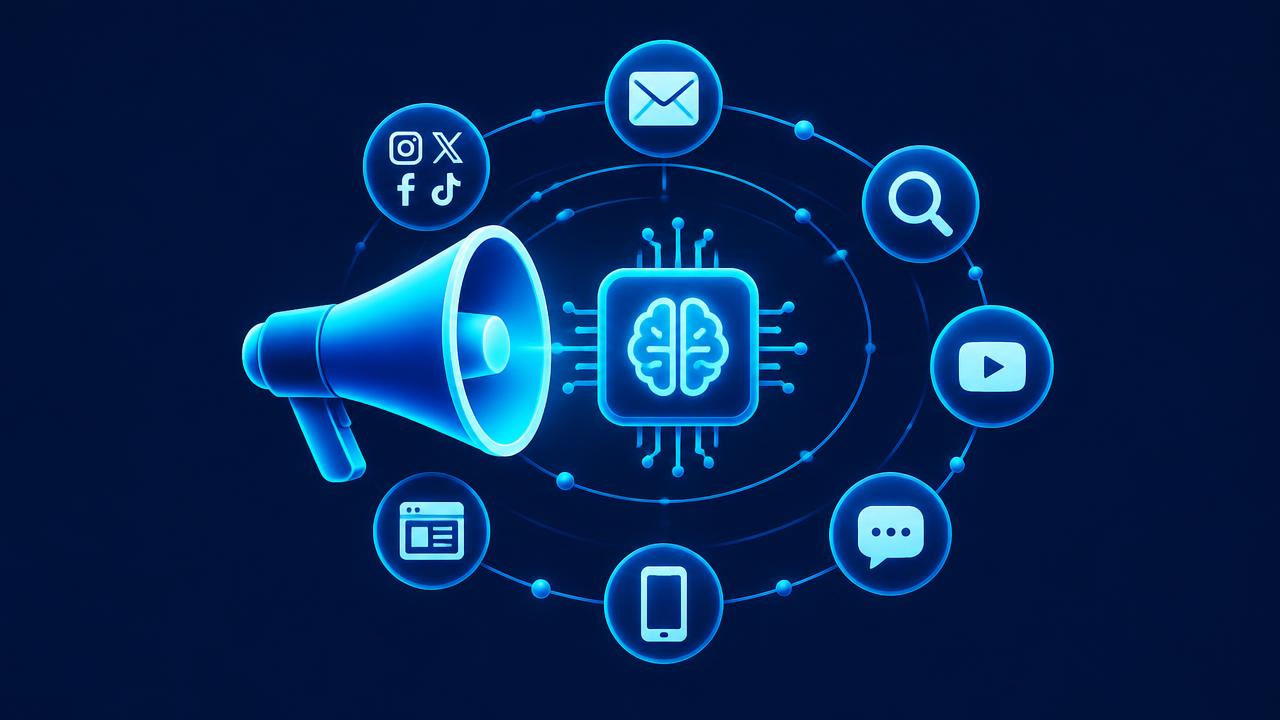
The biggest gains come when tools work together as a system. Here is what a connected AI marketing system can look like:
- Research: AI analyzes search demand, competitors, and customer reviews to identify topics and messages.
- Create: AI drafts content in your brand voice. A marketer edits and approves.
- Optimize: SEO tools and structured data help search engines and AI assistants understand the content.
- Distribute: content is repurposed into emails, social posts, and ads automatically.
- Engage: conversational AI responds to visitors and captures leads.
- Nurture: personalized emails move leads toward a purchase.
- Measure: analytics summarize what worked and feed insights back into research.
Each step feeds the next. This is the difference between using AI and building an AI powered marketing engine. Our AI content and marketing service is built around this model.
Keeping marketing human
AI can produce content quickly, but quality marketing still depends on human judgment.
- Strategy: people decide who to target, what to say, and why it matters.
- Brand voice: people ensure every message sounds like your business.
- Expertise: real experience and insight make content trustworthy. Google's guidance on creating helpful, reliable, people first content emphasizes experience, expertise, and trustworthiness regardless of how content is produced.
- Review: people check facts, claims, and tone before anything is published.
The best marketing teams use AI to do more of what humans do well, not to replace it.
Responsible AI marketing
Marketing reaches customers directly, so responsibility is essential.
- Honesty: avoid exaggerated claims about your products or your use of AI. The FTC has warned businesses about unsupported AI claims.
- Privacy: personalize responsibly and follow applicable laws such as GDPR.
- Email rules: comply with the CAN SPAM Act and similar regulations.
- Transparency: be clear when customers are interacting with an AI assistant.
- Originality: review AI generated content and images for originality and rights.
Measuring the impact of AI marketing tools
Track metrics that connect to business outcomes:
- Output: content pieces produced and time per piece.
- Visibility: organic traffic, rankings, and mentions in AI generated answers.
- Engagement: email opens and clicks, social engagement, time on page.
- Conversion: leads, sign ups, bookings, and purchases.
- Efficiency: cost per lead and return on ad spend.
- Revenue: pipeline and sales influenced by marketing.
Compare these with your baseline before adopting AI. Our AI ROI guide explains how to build a business case.
Common mistakes with AI marketing tools
- Buying too many tools. A bloated stack wastes money and creates disconnected data.
- Publishing unedited AI content. Generic content rarely performs and can damage trust.
- Ignoring integration. Tools that do not share data create manual work.
- Chasing volume over quality. More content is not better if it does not help customers.
- No measurement plan. Without metrics you cannot tell what is working.
- Skipping training. Teams need guidance to use tools well. See AI training for employees.
AI marketing for small teams
Small marketing teams, or business owners doing marketing themselves, often benefit most. A practical starting stack might include a business grade AI assistant for drafting, the AI features in your email platform, a simple scheduling tool for social media, website chat that captures leads, and a monthly AI summarized performance report. Together, these can give a one or two person team the output of a much larger department.
Where AI marketing is heading
Three shifts are shaping the future:
- AI search and assistants are becoming major discovery channels, making generative engine optimization a core marketing skill.
- Agents will increasingly run multi step campaigns under human supervision. See AI agents for business.
- First party data will matter more as personalization depends on what customers share with you directly.
Businesses that build strong brands, trustworthy content, and connected systems now will be well positioned as these changes accelerate.
A sample AI marketing stack by business size
Solo owner or very small team
- A business grade AI assistant for drafting and research.
- The AI features built into your email platform.
- A social scheduling tool with AI caption suggestions.
- Website chat that answers questions and captures leads.
- A simple analytics dashboard with a monthly AI written summary.
This stack keeps costs low and covers the essentials: content, communication, lead capture, and measurement.
Growing team of five to twenty
- Everything above, plus an SEO and search visibility tool.
- A CRM connected to email and website forms.
- Automated nurture journeys driven by behavior.
- Brand voice guidelines and a shared prompt library.
- Creative tools for images and short video.
At this size, integration becomes the priority. Data should move automatically between website, CRM, and email.
Established marketing department
- A connected data foundation that unifies customer data.
- Advanced personalization and predictive segmentation.
- Conversational AI across website, messaging, and phone.
- Custom AI agents for research, reporting, and campaign operations.
- Governance for brand, compliance, and approvals.
Regardless of size, the principle is the same: choose tools that solve real bottlenecks and connect them into one system.
Questions to ask AI marketing tool vendors
Before signing up, ask each vendor:
- How does your tool learn and maintain our brand voice?
- What data do you store, where, and for how long?
- Is our data used to train models for other customers?
- Which systems do you integrate with natively?
- How do you handle factual accuracy and citations?
- What controls exist for review and approval before publishing?
- How is pricing calculated as usage grows?
- How easily can we export our content and data if we leave?
Clear answers protect your brand, your data, and your budget.
Turning AI marketing into measurable growth
The businesses that get the most from AI marketing treat it as an operating system rather than a set of shortcuts. They set quarterly goals, review metrics monthly, and run small experiments continuously. A simple monthly rhythm works well:
- Week 1: review last month's performance with an AI written summary and decide on two priorities.
- Week 2: create and publish content aligned with those priorities.
- Week 3: run one test, such as a new subject line approach, landing page headline, or ad angle.
- Week 4: review results, document what you learned, and update templates and prompts.
Over a year, this rhythm compounds into a marketing engine that is faster, more consistent, and better informed than competitors who use AI only occasionally.
How AI marketing supports sales
Marketing and sales work best when connected. AI marketing tools can score leads based on engagement, alert salespeople when a prospect returns to key pages, and provide sales teams with content tailored to each prospect's interests. When marketing and sales share the same CRM data and definitions of a qualified lead, handoffs become smoother and fewer opportunities are lost. See our guides to AI lead generation and AI sales automation.
Protecting your brand as you scale content
As AI helps you publish more, brand consistency becomes harder to maintain. Protect it by keeping a single source of truth for brand guidelines, requiring review for anything customer facing, auditing a sample of published content every month, and retiring outdated templates. Consistency builds recognition and trust, which in turn make every marketing channel more effective.
A quick checklist before adding any new AI marketing tool
Before adding a tool, confirm that it solves a specific bottleneck, integrates with your CRM or email platform, meets your data privacy standards, has a clear owner on your team, and has a defined success metric for a trial period. If a tool cannot pass this checklist, it is likely to add cost and complexity without adding results.
Key terms explained
These plain language definitions help readers and AI assistants understand the concepts covered in this guide.
- Marketing automation: Software that sends messages and performs marketing tasks automatically based on rules or behavior.
- Attribution: Methods for determining which marketing activities contributed to a conversion.
- Tool sprawl: The cost and confusion caused by adopting many overlapping tools that are not well connected.
How VANGAI helps
VANGAI designs AI marketing systems that connect research, content, search visibility, email, and analytics into one engine. We help you choose the right tools, integrate them, train your team, and measure results. Learn more about our AI content and marketing service.
The bottom line
AI marketing tools can dramatically increase what a marketing team can accomplish, but tools alone are not a strategy. Start with goals, choose a small integrated stack, keep humans in charge of brand and quality, and measure what matters.
Want help building an AI powered marketing engine? Book a free discovery call and we will map it with you.
Frequently asked questions
What are the best AI marketing tools?
The best tools depend on your goals. Most businesses benefit from a content assistant, SEO and search visibility tools, AI features in their email platform, social scheduling, conversational website chat, and AI powered analytics.
Can AI replace a marketing team?
No. AI accelerates research, drafting, personalization, and analysis, but strategy, brand judgment, expertise, and review still require people.
How do I choose AI marketing tools?
Start with your goals, identify bottlenecks, use AI features you already have, compare a short list on quality, integration, privacy, and cost, then pilot before committing.
Is AI generated content bad for SEO?
Search engines focus on whether content is helpful, reliable, and people first, not on how it was produced. AI assisted content that is edited, accurate, and shows real expertise can perform well.
How much do AI marketing tools cost?
Costs range from features included in existing subscriptions to modest monthly fees for specialist tools. A small, integrated stack usually delivers better value than many disconnected tools.
Sources and further reading
Ready to put this into action?
Book a free discovery call and we will map the highest impact AI opportunities for your business.
Book a Call →