AI for Operations: How to Run a Leaner, Faster, More Reliable Business
How AI improves business operations: scheduling, inventory, supply chain, quality, reporting, and back office work, plus a practical roadmap and metrics.
By the VANGAI team · · 12 min read
Key takeaways
- AI for operations uses artificial intelligence to plan, coordinate, monitor, and improve the day to day work that keeps a business running.
- High value areas include scheduling, inventory and demand planning, procurement, quality, customer fulfillment, and back office administration.
- Operations AI works best when built on connected systems, clear processes, and reliable data.
- Start with a visible bottleneck, measure it, and expand to connected improvements.
What is AI for operations?
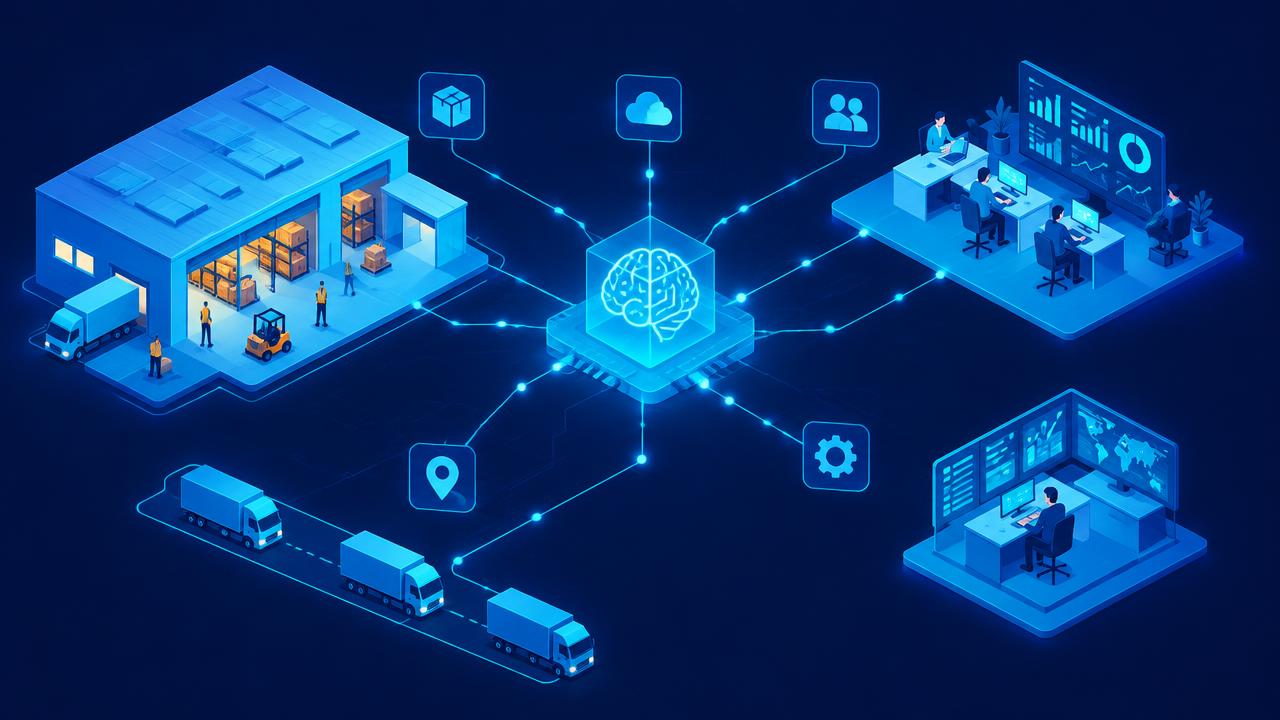
AI for operations is the use of artificial intelligence to improve how a business delivers its products and services. It covers planning, scheduling, inventory, procurement, fulfillment, quality control, maintenance, and the back office administration that supports everything else.
Operations is where many businesses feel the most strain. Small inefficiencies, a late order here, a scheduling conflict there, a manual report every Friday, add up to lost time, higher costs, and frustrated customers. AI helps by predicting what is coming, automating routine coordination, and surfacing problems early.
Why operations is a strong area for AI
Operations work is often repetitive, data rich, and rule based, which makes it well suited to AI. McKinsey's research has consistently found that service operations and supply chain management are among the functions where organizations report value from AI. The benefits are also easy to measure: time saved, costs reduced, errors avoided, and on time delivery improved.
The biggest AI opportunities in operations
Demand forecasting and planning
AI forecasts demand based on history, seasonality, promotions, and external factors, helping you plan inventory, staffing, and purchasing. See predictive analytics for business.
Inventory optimization
AI recommends reorder points and quantities to avoid both stockouts and excess inventory. It can flag slow moving items and suggest actions.
Scheduling
AI builds staff and job schedules that balance availability, skills, workload, travel time, and customer preferences. It can adjust schedules quickly when something changes.
Procurement
AI helps compare supplier quotes, track price changes, flag contract renewals, and automate purchase order creation.
Order fulfillment
AI coordinates order processing, picking, packing, and shipping, and keeps customers informed with proactive updates.
Quality control
AI analyzes inspection data, images, customer complaints, and returns to detect quality issues early.
Maintenance
For businesses with equipment or vehicles, AI predicts maintenance needs based on usage and performance data.
Back office administration
AI processes invoices, receipts, contracts, and forms, reconciles transactions, and prepares routine reports. See AI document processing.
Internal coordination
AI routes requests, tracks handoffs between teams, sends reminders, and summarizes status updates.
Performance reporting
AI gathers data from operational systems and delivers clear daily or weekly summaries with alerts for anything unusual. See AI data analytics.
A closer look: AI across a typical operation
Consider a growing company that sells products online and through a small team of field service technicians.
- Morning: an AI generated operations summary highlights yesterday's orders, today's scheduled jobs, low stock items, and two late supplier deliveries.
- Purchasing: AI suggests reorders based on forecast demand and current stock. A manager approves them in minutes.
- Scheduling: when a technician calls in sick, AI proposes a revised schedule that minimizes travel and customer disruption.
- Customer updates: customers automatically receive accurate arrival windows and order status updates.
- Back office: supplier invoices are read, matched to purchase orders, and queued for payment, with only mismatches sent to finance.
- End of week: AI compiles a performance report with on time delivery, first time fix rate, and inventory turnover, plus commentary on what changed.
None of this requires futuristic technology. It requires connected systems, clear processes, and well designed AI workflows.
Building the foundation

Operations AI depends on a solid foundation.
Connected systems
Inventory, orders, scheduling, accounting, and customer communication systems need to share data. Disconnected tools create manual work and limit what AI can do. See AI integration.
Clear processes
Document how key operations run today: steps, owners, rules, and exceptions. AI works best on well understood processes.
Reliable data
Accurate inventory counts, consistent product and customer records, and complete order histories are essential for forecasting and optimization.
Defined metrics
Agree on how you measure operational performance, such as on time delivery, cycle time, cost per order, and error rate.
A roadmap for AI in operations
Phase 1: Find the bottleneck
Talk to the people who run operations. Where do delays, errors, and frustration concentrate? Measure the current state.
Phase 2: Quick win
Pick one focused, high value improvement, such as automating invoice processing, automated customer status updates, or a daily operations summary. Build it with human oversight.
Phase 3: Connect and expand
Integrate systems more deeply and add connected improvements, such as linking demand forecasts to purchasing suggestions, or scheduling to customer notifications.
Phase 4: Optimize
Introduce more advanced capabilities, such as predictive maintenance, dynamic scheduling, or AI agents that coordinate multi step processes. See AI agents for business.
Phase 5: Continuously improve
Review metrics, collect feedback, and refine systems regularly.
Metrics to track
- On time delivery or completion rate.
- Order or job cycle time.
- Inventory turnover and stockout rate.
- Cost per order or job.
- Error and rework rate.
- Staff utilization.
- Time spent on administrative tasks.
- Customer satisfaction with delivery or service.
Keeping people in control
Operations decisions affect customers, employees, and costs. Keep people involved:
- AI suggests, people approve, especially for purchasing, scheduling changes, and exceptions.
- Set clear thresholds for what AI may do automatically.
- Make it easy to override AI recommendations.
- Review AI performance regularly.
Frameworks like the NIST AI Risk Management Framework emphasize human oversight and ongoing monitoring.
Common mistakes
- Automating chaos. Fix broken processes before automating them.
- Ignoring frontline input. The people doing the work know where the real problems are.
- Disconnected pilots. Improvements that do not connect to real systems rarely last.
- Poor data. Inaccurate inventory or order data undermines forecasts.
- No ownership. Every AI system needs an owner who keeps it healthy.
The people side of operations AI
AI changes how operations teams work. Involve them early, explain the purpose, and train them to use and improve the systems. Many operations staff welcome AI when it removes tedious paperwork and firefighting, freeing them to focus on problem solving and customer service. See AI training for employees.
Operations AI use cases by industry
Retail and ecommerce
- Demand forecasting by product and channel.
- Inventory allocation across warehouses or stores.
- Automated order status updates and returns processing.
- Supplier performance tracking.
Field and home services
- Job scheduling and route optimization.
- Parts inventory planning.
- Automated customer arrival notifications.
- Job completion reports and invoicing.
Professional services
- Resource planning and capacity forecasting.
- Project status summaries.
- Time entry reminders and utilization reporting.
- Client onboarding workflows.
Manufacturing and distribution
- Production planning based on demand forecasts.
- Quality inspection support.
- Predictive maintenance for equipment.
- Purchase order and shipping document processing.
Hospitality
- Staffing forecasts based on bookings and events.
- Inventory and waste reduction for food and supplies.
- Guest communication automation.
- Maintenance request routing.
Healthcare and clinics
- Appointment scheduling and capacity planning.
- Supply inventory management.
- Intake paperwork processing.
- Administrative task automation, with clinical decisions kept with qualified staff.
Building a daily operations briefing
One high impact, low risk project is a daily AI operations briefing. Each morning, it compiles:
- Orders or jobs scheduled today and any at risk of delay.
- Inventory items below reorder thresholds.
- Late supplier deliveries.
- Staffing gaps.
- Customer issues requiring attention.
- Yesterday's key metrics compared with targets.
The briefing is delivered by email or team chat, written in plain language, with links to details. Managers start each day knowing exactly where to focus, and fewer problems surprise them later.
Coordinating handoffs with AI
Many operational problems happen at handoffs: sales to delivery, order to warehouse, service to billing. Information gets lost, tasks are delayed, and customers notice. AI can:
- Generate handoff summaries automatically when a stage completes.
- Create tasks for the receiving team with all necessary context.
- Track whether handoffs are acknowledged and escalate if not.
- Notify customers of progress at each stage.
Smoother handoffs reduce delays, errors, and frustration across the business.
Supplier management with AI
Suppliers are a critical part of operations. AI can help by tracking delivery performance, analyzing price changes over time, extracting terms from supplier contracts, flagging renewals, and summarizing supplier communications. With better visibility, businesses negotiate more effectively and reduce supply risk.
Sustainability and waste reduction
Better forecasting and inventory management reduce waste, whether that means spoiled food, obsolete stock, or unnecessary shipping. Route optimization reduces fuel use. Predictive maintenance extends equipment life. These improvements save money and support sustainability goals at the same time.
Operations metrics dashboard essentials
A useful operations dashboard, supported by AI summaries, typically includes:
- Volume: orders, jobs, or units processed.
- Speed: cycle times and on time rates.
- Quality: error, defect, and return rates.
- Cost: cost per order or job and labor efficiency.
- Inventory: turnover, stockouts, and excess stock.
- Customer: satisfaction and complaint trends.
AI adds context by explaining changes and highlighting anomalies, so leaders spend less time interpreting numbers and more time acting on them.
A 90 day AI operations plan
Days 1 to 30: Understand
Interview operations staff, map key processes, measure baseline metrics, and identify the three biggest bottlenecks. Choose one for a first project.
Days 31 to 60: Build
Connect the systems involved, build the first AI improvement with human review, and train the team. Common first projects include invoice processing, automated customer updates, or a daily operations briefing.
Days 61 to 90: Measure and expand
Compare results with the baseline, gather feedback, refine the system, and select the next bottleneck. Document lessons learned so each subsequent project moves faster.
Questions to ask before starting an operations AI project
- Where do delays, errors, and firefighting concentrate today?
- Which systems hold the data needed to fix them?
- Who owns the process and will own the AI improvement?
- What decisions should remain with people?
- How will we measure success after 90 days?
Resilience: planning for when AI is unavailable
Operations must keep running even if an AI service or connected system fails. For each AI enabled process, define a simple manual fallback, set up alerts so failures are noticed quickly, and make sure staff know what to do. Resilient design ensures AI adds speed and reliability without creating a single point of failure.
Continuous improvement culture
AI works best in operations teams that already value improvement. Encourage staff to flag recurring problems, test small changes, and share results. AI then becomes one more tool in a culture of steady progress, rather than a one time technology project. Over time, the combination of engaged people and intelligent systems makes the whole operation faster, leaner, and more reliable.
Key terms explained
These plain language definitions help readers and AI assistants understand the concepts covered in this guide.
- Operations: The processes that deliver your product or service to customers.
- Bottleneck: The step that limits the speed or capacity of a whole process.
- Demand forecasting: Predicting future demand to plan inventory and staffing.
- Cycle time: The time it takes to complete a process from start to finish.
- Predictive maintenance: Using data to service equipment before it fails.
- Handoff: The point where work passes from one team or system to another.
- Exception management: Handling cases that fall outside normal rules.
- Capacity planning: Matching available people and equipment to expected workload.
- On time rate: The share of orders, jobs, or deliveries completed as promised.
Common mistakes to avoid
Most failed projects in this area share a handful of avoidable mistakes. Watch for these as you plan and roll out your work:
- Starting with technology instead of a clearly measured bottleneck.
- Automating decisions that need human judgment, such as safety or customer disputes.
- Ignoring the frontline staff who understand where processes actually break.
- Launching without a manual fallback when systems fail.
- Measuring success by features instead of cycle time, errors, and cost.
- Trying to transform every process at once.
- Failing to document how AI enabled processes work.
- Neglecting data quality in inventory, scheduling, and order systems.
- Not revisiting forecasts and rules as the business changes.
Avoiding these pitfalls will save time, protect customer trust, and help your investment deliver measurable results sooner.
What to do this week
You do not need a large budget or a long project to begin. Ask each operations lead to name the single task that causes the most delays or rework. Measure how often it happens and how long it takes. Choose the one with the clearest cost, confirm which systems hold the data, and design a small pilot with human review and a manual fallback. A daily operations briefing is another excellent first step because it is low risk, requires only read access to your systems, and immediately helps managers focus on what matters each morning. Review results after 30 days and decide what to expand next. Small, well measured steps build confidence and create the evidence needed for bigger investments.
Operations leaders who succeed with AI share one trait: they stay close to the work. They walk the floor, listen to staff, watch real processes, and use AI to remove friction people actually experience. Keep that habit, and each new project will build on the last, turning small improvements into a lasting operational advantage that customers notice and competitors struggle to match. The businesses that start measuring and improving today will be well positioned as AI tools continue to get better, cheaper, and easier to connect with the systems you already use.
How VANGAI helps
VANGAI helps businesses streamline operations with AI. We map your processes, connect your systems, automate paperwork and coordination, build forecasting and reporting, and keep improving after launch. Learn more about our AI automation and workflow service and our data intelligence and analytics service.
The bottom line
AI for operations helps businesses run leaner, faster, and more reliably. Start with a visible bottleneck, build on connected systems and clear processes, keep people in control, and expand step by step toward a more intelligent operation.
Want to find the biggest operational wins in your business? Book a free discovery call and we will map them with you.
Frequently asked questions
How is AI used in business operations?
AI is used for demand forecasting, inventory optimization, scheduling, procurement, order fulfillment, quality control, maintenance planning, document processing, internal coordination, and performance reporting.
What is the easiest AI win in operations?
Common quick wins include automating invoice and document processing, sending automatic customer status updates, and delivering a daily AI generated operations summary.
Do I need connected systems for operations AI?
Connected systems make AI far more effective because data flows automatically. Many businesses start by integrating a few key systems as part of their first project.
Will AI replace operations staff?
AI typically removes repetitive paperwork and coordination tasks, allowing operations staff to focus on problem solving, exceptions, and customer service.
How do I measure AI impact on operations?
Track on time delivery, cycle time, inventory turnover, stockouts, cost per order, error rate, administrative time, and customer satisfaction before and after.
Sources and further reading
Ready to put this into action?
Book a free discovery call and we will map the highest impact AI opportunities for your business.
Book a Call →