AI Onboarding Automation: Get Every New Customer to Value Faster
How AI onboarding automation guides new customers from signup to success with personalized checklists, timely nudges, and instant answers, cutting churn and support load.
By the VANGAI team · · 6 min read
Key takeaways
- AI onboarding automation guides each new customer from signup to their first win with personalized steps, timely nudges, and instant answers.
- Customers who reach value quickly stay; those who stall in the first weeks rarely come back.
- The best systems adapt the journey to each customer, watch for stall signals, and alert your team before someone gives up.
- Measure time to first value, activation rate, onboarding completion, and early churn to prove impact.
What is AI onboarding automation?
AI onboarding automation uses artificial intelligence to guide every new customer from the moment they sign up to the moment they get real value from your product or service. It includes personalized welcome sequences, adaptive checklists, instant answers to setup questions, timely nudges when someone stalls, and alerts to your team when a customer needs human help.
Traditional onboarding sends everyone the same drip emails on the same schedule. AI onboarding adapts. A customer who finished setup in a day gets different messages than one who has not logged in for a week. Questions get answered instantly instead of waiting in a support queue.
Why onboarding decides whether customers stay
The first days and weeks of a customer relationship carry outsized weight. A new customer is motivated but fragile: they have not yet formed habits around your product, and every point of friction is a chance to drift away. Research on retention, including work summarized by Bain and Company on loyalty, consistently shows that early experience predicts long term retention.
The failure pattern is familiar:
- A customer signs up with enthusiasm, hits one confusing step, and postpones.
- Generic welcome emails arrive on a schedule that ignores what the customer has actually done.
- By the time anyone notices the customer went quiet, they have mentally moved on.
AI onboarding exists to catch every one of these moments.
What an AI onboarding system does
Personalized welcome and setup paths
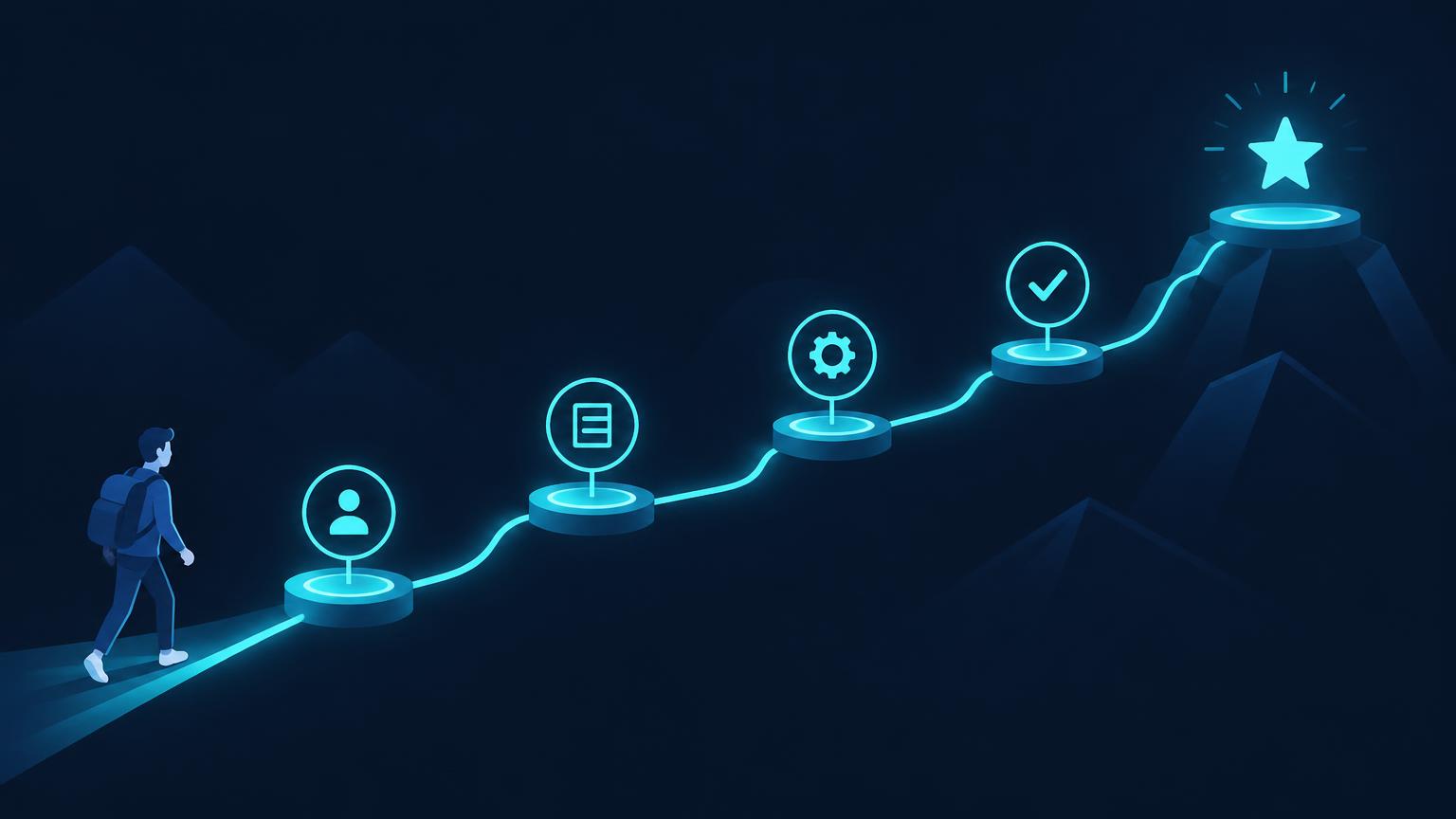
Based on what the customer told you at signup and what they do in the first session, the AI assembles a path that fits them: which features to set up first, which steps to skip, and what "success" looks like for their use case.
Instant setup help
New customers ask questions at the exact moment they are stuck. An AI assistant trained on your documentation answers immediately, inside the product or by chat and email, instead of leaving them to search a help center.
Adaptive checklists and nudges
The system tracks which milestones each customer has reached and nudges them toward the next one, with timing based on behavior rather than a fixed calendar. A stalled customer gets a helpful, specific message: "You are one step away, here is the two minute video for connecting your calendar."
Stall detection and human alerts
When a customer shows the signals of giving up, such as no logins, unfinished setup, or ignored messages, the AI alerts your team with context so a human can reach out at the moment it matters most.
Milestone celebration and expansion
When a customer hits their first win, the system acknowledges it and points to the next valuable thing. Onboarding becomes the start of expansion, not just setup.
Defining your "first value" moment
Everything in onboarding anchors on one question: what is the first moment a customer gets real value? For a scheduling tool it might be the first booked appointment. For a CRM, the first imported contact and sent email. For a service business, the first completed project milestone.
Define this moment precisely, then work backwards:
- List every step between signup and first value.
- Mark which steps customers most often abandon.
- Automate guidance, answers, and nudges around those steps first.
Our AI readiness assessment guide can help you map this journey before building anything.
Where AI onboarding fits
- Software and SaaS: setup guidance, feature adoption, and activation. See AI for SaaS companies.
- Agencies and services: client intake, document collection, and kickoff preparation, closely related to AI document processing.
- Education and courses: student orientation and early engagement. See AI for online education.
- Financial and professional services: compliant intake and account setup. See AI for financial advisors.
Metrics that matter
- Time to first value: how long from signup to the first value moment.
- Activation rate: the share of new customers who reach first value at all.
- Onboarding completion: how many finish the full setup path.
- Early churn: customers lost in the first 30 to 90 days.
- Support tickets per new customer: how much help each onboarding requires.
- Nudge response rate: how often a nudge leads to the intended action.
Common mistakes to avoid
- One path for everyone. Different customers need different journeys. Segment at least by use case.
- Email only. Reach customers where they are: in product, by chat, and by text where appropriate.
- Nagging instead of helping. Every nudge should make the next step easier, not just louder.
- No human safety net. Automation catches most stalls, but a timely human call saves the rest.
- Measuring emails sent. Measure customers activated, not messages delivered.
Responsible use
Onboarding systems use customer behavior data, so be transparent about what you track, collect only what you need, and follow privacy laws such as GDPR where they apply. If you send text messages, follow messaging consent rules such as the TCPA with clear opt in and opt out.
A 60 day rollout plan
Days 1 to 15
- Define your first value moment and map the steps to reach it.
- Analyze where current customers stall or abandon.
- Draft the core setup content: guides, videos, and answers.
Days 16 to 40
- Launch the AI assistant for setup questions.
- Build the adaptive checklist and first behavior based nudges.
- Set up stall alerts for your team.
Days 41 to 60
- Personalize paths by customer segment.
- Add milestone celebrations and next step recommendations.
- Review activation and time to value against the baseline.
How VANGAI helps
VANGAI builds AI onboarding systems that guide every new customer to their first win, answer setup questions instantly, and alert your team before anyone slips away. See our AI automation services for how we work.
The bottom line
AI onboarding automation turns the fragile first weeks of a customer relationship into a guided path to value. Define the first win, personalize the journey, nudge based on behavior, and measure activation and early churn.
Ready to get every new customer to value faster? Book a free discovery call and we will map your onboarding journey.
Frequently asked questions
What is the difference between onboarding automation and a welcome email sequence?
A welcome sequence sends everyone the same emails on a fixed schedule. AI onboarding adapts to what each customer has actually done, answers their questions instantly, and alerts your team when someone is about to give up.
How do I define "first value" for my business?
It is the first moment a customer gets a real, tangible result: a first booking, a first sent campaign, a first completed milestone. Define it precisely, then design every onboarding step to lead there.
Will customers mind automated nudges?
Not when the nudges are helpful and well timed. A message that makes the next step easier feels like good service; a generic reminder sent on a schedule feels like spam.
What metrics should I track first?
Start with time to first value and activation rate. Together they tell you whether new customers are reaching the moment that makes them stay.
How long does it take to set up AI onboarding?
A focused first version covering your main setup path and stall alerts typically launches within four to eight weeks, then improves as you learn where customers struggle.
Sources and further reading
Ready to put this into action?
Book a free discovery call and we will map the highest impact AI opportunities for your business.
Book a Call →