AI for Manufacturing: Less Downtime, Better Quality, Faster Quotes
How manufacturers use AI for quoting, quality, maintenance, and customer communication. Practical use cases, costs, and rollout steps.
By the VANGAI team · · 12 min read
Key takeaways
- AI helps manufacturing company teams respond to customers instantly, automate repetitive work, and grow without adding headcount.
- The fastest wins in manufacturing are usually lead and inquiry response, scheduling, document work, and marketing.
- You do not need a technical team. Start with one painful workflow, measure hours saved, and expand.
- Compliance and human review matter in manufacturing; AI drafts and organizes, your people decide.
What does AI for Manufacturing actually mean?
AI for Manufacturing means using artificial intelligence to handle the repetitive, time sensitive work that slows manufacturing company teams down. It is not about replacing your people. It is about giving them a tireless assistant that answers customers instantly, drafts documents and messages for review, keeps data organized, and flags the things that need human attention.
The businesses seeing real results are not doing anything exotic. They picked one or two painful workflows, automated them carefully, measured the outcome, and expanded from there. That is exactly the approach this guide walks through.
Why Manufacturing businesses are adopting AI now
Three forces make this the right moment. First, the tools matured. Modern AI can hold natural conversations, read documents accurately, and write in your brand voice, none of which was reliable a few years ago. Second, customer expectations changed. People expect instant answers at any hour, and the business that responds first usually wins. Third, labor is expensive and hard to find. AI lets your existing team handle more volume without burning out.
Research backs the productivity case. McKinsey's analysis of generative AI estimates that current technology can automate a large share of the activities that consume employee time, with the biggest impact in customer operations, marketing and sales, and administrative work. For a manufacturing company, those are exactly the areas where hours disappear every week.
There is also a competitive dynamic. AI adoption in manufacturing is still early enough that a well executed implementation is a genuine differentiator. The manufacturing company that answers every inquiry in seconds while competitors take hours does not just save time; it wins business that used to leak away.
The three problems AI solves first in manufacturing
Every manufacturing company we look at struggles with a version of the same three bottlenecks:
- RFQs sitting in inboxes while competitors quote first. This is where revenue leaks. Slow responses and missed messages quietly send customers to competitors, and the cost never shows up on a report.
- Unplanned downtime wrecking production schedules. This is where hours leak. Skilled people spend their days on work that follows a repeatable pattern, which is exactly what AI handles well.
- Quality issues discovered too late in the run. This is where growth stalls. The work that builds long term value, like follow up, retention, and marketing, gets skipped because urgent tasks crowd it out.
A good AI implementation attacks all three, but not at once. You start with the one that hurts most.
The five highest impact AI use cases for Manufacturing
1. Quote automation
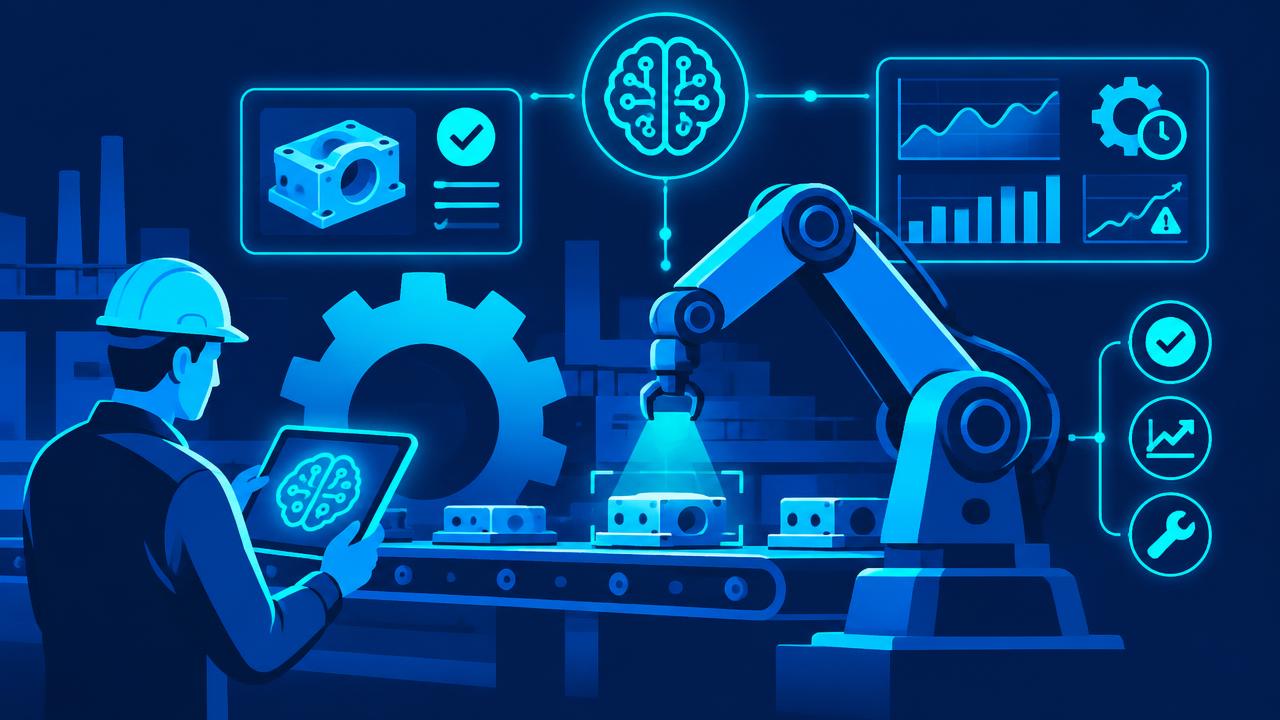
AI reads RFQ drawings and specs, pulls historical job data, and drafts quotes for your estimators to refine. Fast quotes win work.
Track these metrics to prove it works: quote turnaround time, quotes per week, win rate.
2. Predictive maintenance
AI analyzes sensor and maintenance data to flag equipment likely to fail, so you schedule repairs before breakdowns.
Track these metrics to prove it works: unplanned downtime, maintenance cost, overall equipment effectiveness.
3. Quality inspection support
AI assisted vision and data checks catch defects earlier and keep inspection records organized automatically.
Track these metrics to prove it works: defect escape rate, scrap rate, inspection time.
4. Production scheduling support
AI suggests schedules that balance due dates, changeovers, and capacity, with planners approving the final plan.
Track these metrics to prove it works: on time delivery, changeover time, schedule adherence.
5. Customer communication
AI answers order status questions, sends proactive delay notices, and keeps portals updated without manual work.
Track these metrics to prove it works: status inquiry volume, customer satisfaction, late order visibility.
!Automated workflow connecting everyday tasks
A realistic example of AI in a manufacturing company
A precision shop automated RFQ intake and added maintenance alerts on critical machines. Quote turnaround dropped from days to hours, a major breakdown was avoided by an early warning, and customers stopped calling for status because updates arrived automatically. The shop also found that faster quoting changed which jobs they won, because buyers often award work to the first credible number they receive.
Note that this is an illustrative scenario based on common patterns, not a specific client case study. Your results depend on your volume, your current processes, and how carefully the system is set up. That is why measurement matters from day one.
How AI answers the questions your customers ask most
One underappreciated benefit of AI in manufacturing is consistency. Your best team member gives great answers on a good day. An AI assistant trained on your approved content gives that same quality answer every time, at 2 pm and 2 am. It never gets impatient, never forgets a detail, and never leaves a message unanswered over a holiday weekend.
The key is training it on your real material: your services, your pricing approach, your policies, and the answers your team gives today. Generic AI gives generic answers. AI grounded in your business gives answers that sound like you. This is also what makes the difference for AI search visibility; our guide to generative engine optimization explains how clear, well structured answers help your business get cited by AI assistants when people ask for recommendations in manufacturing.
What AI cannot do in manufacturing (and should never do)
Honesty about limits builds better implementations. AI should not make final judgment calls that require your professional license, your relationships, or your accountability. It should not improvise on sensitive topics, and it should never be the last review on anything compliance related. Operational technology and customer drawings need tight security. Keep AI inside controlled systems, respect customer confidentiality agreements, and keep engineers making final process decisions.
The right mental model: AI is the world's best junior assistant. It prepares, drafts, organizes, and responds. Your team reviews, decides, and owns the relationship. Businesses that keep that boundary clear get the speed benefits without the risk.
How much does AI cost for a manufacturing company?
Costs fall into three buckets:
- Off the shelf tools. Many capabilities, like AI assisted email, scheduling, and content drafting, live inside software you may already pay for. Budget tens to a few hundred dollars per month.
- Focused custom systems. A purpose built assistant that answers inquiries, qualifies them, and books appointments, connected to your ERP, quality system, and machine monitoring data, typically runs from a few thousand dollars to build plus modest monthly operating costs.
- Larger integrated programs. Multiple connected workflows across the business, with custom integrations and reporting, cost more but compound in value.
The right question is not what AI costs but what the current bottleneck costs. If slow response loses even one or two customers a month, or a skilled team member spends ten hours a week on work AI can draft, the math usually favors acting. Our guide to measuring AI ROI walks through the calculation step by step.
Signs your manufacturing company is ready for AI
You do not need to be a technology company to be ready. You are ready if any of these sound familiar: inquiries regularly wait hours for a response, skilled staff spend more than a few hours a week on repetitive document or data work, follow up depends on individual memory, marketing happens in bursts when someone finds time, or you have turned away work because the team was at capacity. Any one of these is a workflow AI can help with, and most manufacturing businesses recognize several.
You are probably not ready if your core processes are undocumented and different every time, because AI needs a pattern to follow. The fix is simple: write down how the workflow should work first, then automate it. That documentation exercise alone usually pays for itself in clarity, even before any technology is involved.
Buy, build, or partner: choosing your approach in manufacturing
You have three realistic paths. The first is using AI features already inside your existing software. This is the cheapest and fastest option, and it is worth auditing your current tools before buying anything new. The downside is that built in features are generic; they do not know your business deeply.
The second path is connecting off the shelf AI tools to your systems with automation platforms. This works well for straightforward workflows like drafting content or routing messages, and a capable team member can often run it. The risk is a patchwork of fragile connections that nobody owns.
The third path is a purpose built system designed around your workflows, trained on your content, and connected directly to your ERP, quality system, and machine monitoring data. This costs more upfront but produces the most reliable results, because every part is designed for how your manufacturing company actually operates. Most businesses end up with a mix: built in features where they exist, and a custom system for the workflow that drives the most revenue.
What a typical week looks like after AI
It helps to make this concrete. Before AI, a typical week in a manufacturing company includes hours of inbox triage, phone tag, manual data entry, and marketing that slips to next week. After a focused implementation, the week looks different. Inquiries that arrived overnight already have answers and booked next steps waiting in the calendar. Routine documents are drafted and queued for review instead of written from scratch. Follow ups that used to depend on someone remembering now happen automatically. The team's calendar shifts toward the work that actually requires their expertise.
This is the pattern that matters more than any individual feature: AI absorbs the volume work, and your team's time concentrates on the judgment work. That shift is where the return on investment comes from, and it is also why teams that adopt AI well tend to report higher job satisfaction, because the tedious part of the job shrinks.
How to measure whether it is working
Pick three numbers before you start and review them monthly. The first is a time metric: hours per week spent on the workflow you automated, or response time to new inquiries. The second is a volume metric: customers handled, appointments booked, or documents processed. The third is a money metric tied to your business, such as quote turnaround time. If all three move in the right direction over a quarter, the implementation is working. If time drops but quality complaints rise, tune the training content and escalation rules before expanding.
Keep the measurement simple. A spreadsheet updated monthly beats a dashboard nobody checks. The goal is an honest feedback loop, not analytics theater.
Getting your team on board
The human side decides whether AI sticks. Introduce it as help, not surveillance or replacement. Involve the people who do the workflow today in designing how the AI should handle it; they know the edge cases that break naive setups. Celebrate the hours saved publicly, and redirect that time to work people actually enjoy. The businesses that fail at AI adoption almost always fail on change management, not on technology.
A practical tip: name one internal owner for the system. Someone who reviews outputs weekly, gathers team feedback, and works with your partner or vendor on tuning. AI systems improve with attention and drift without it.
How AI search is changing how customers find you
More people now ask AI assistants for recommendations instead of scrolling search results. When someone asks an assistant for the best option in manufacturing, the assistant favors businesses with clear, structured, consistent information across their website and profiles. That means your service pages should answer real questions directly, your reviews should be recent and responded to, and your content should demonstrate genuine expertise. The articles and pages you publish today are the material AI assistants will quote tomorrow, which makes a steady publishing habit one of the highest leverage marketing investments a manufacturing company can make.
Frequently overlooked details
A few small things separate smooth implementations from frustrating ones. Write down your escalation rules before launch, in plain language everyone understands. Decide who owns the AI system's quality and give them an hour a week for review. Keep a simple log of the questions the AI could not answer; that log is your roadmap for improving it. And revisit your setup quarterly, because both the technology and your business keep moving.
A 90 day plan to get started
Days 1 to 30: pick and measure one workflow. Choose the bottleneck that costs the most, usually quote turnaround time. Document how it works today, how long it takes, and what a good outcome looks like. This baseline is what you will measure against.
Days 31 to 60: implement carefully. Build or configure the system with a partner or your team. Train it on your real content, connect it to your ERP, quality system, and machine monitoring data, and test it against real scenarios before it touches a real customer. Set the escalation rules: what it handles alone, and what always goes to a person.
Days 61 to 90: measure and expand. Compare results against your baseline. Track hours saved, response times, and the revenue metric that matters. Fix what is rough, then pick the next workflow. Our AI readiness assessment guide can help you score where your business stands before you start.
Common mistakes to avoid
- Automating everything at once. One proven workflow beats five half working ones.
- Skipping the baseline. Without before numbers, you cannot prove the after.
- Generic training data. AI trained on generic content gives generic answers that erode trust.
- No human review path. Every system needs a clean handoff to a person for sensitive cases.
- Set and forget. Review transcripts and outputs monthly. Small tuning compounds into big quality gains.
Key terms, explained plainly
- AI assistant or agent: software that can hold a conversation and take actions like booking appointments or updating records.
- Training or grounding: giving the AI your real business content so its answers reflect your business, not the generic internet.
- Escalation: the rule set that decides when the AI hands a conversation to a human.
- Integration: connecting the AI to your existing tools so information flows without copy and paste.
- Deflection rate: the share of inquiries the AI resolves fully without a human.
The bottom line for Manufacturing
AI is not a someday technology for manufacturing; it is a practical advantage available right now. The manufacturing companyes that win are the ones that start with one painful workflow, measure honestly, keep humans in charge of judgment, and expand steadily. If you want help mapping the highest impact opportunity in your business, book a call with our team and we will walk through it together.
Frequently asked questions
Is AI practical for a small manufacturing company?
Yes. Small teams often benefit the most because every saved hour is a larger share of total capacity. Start with one workflow like inquiry response or scheduling, prove the value, and expand from there.
Will AI replace my staff?
In practice, AI removes the repetitive parts of roles so your people spend time on the work that needs judgment and relationships. Most businesses redeploy the saved hours rather than cutting heads.
How long does it take to see results?
A focused first workflow, like instant inquiry response, typically shows measurable results within the first month. Larger programs compound over a quarter or two.
Is my data safe with AI?
It can be, if you choose tools with enterprise data handling terms, control access, and keep sensitive decisions with humans. Operational technology and customer drawings need tight security.
What should I automate first?
Start with the workflow that wastes the most hours or loses the most revenue. For most manufacturing businesses that is quote turnaround time, followed by document work and marketing.
Sources and further reading
Ready to put this into action?
Book a free discovery call and we will map the highest impact AI opportunities for your business.
Book a Call →